I.
My name is Eincla. In 1884 is my year of birth, if you want to call it that. In Upper Silesia.
What I have not seen. Countless stories I can tell you. For laughs. For crying. To think. Over 100 years that I have lived. Over a dozen decades of change. Over a century in which I was allowed to call myself Eincla.
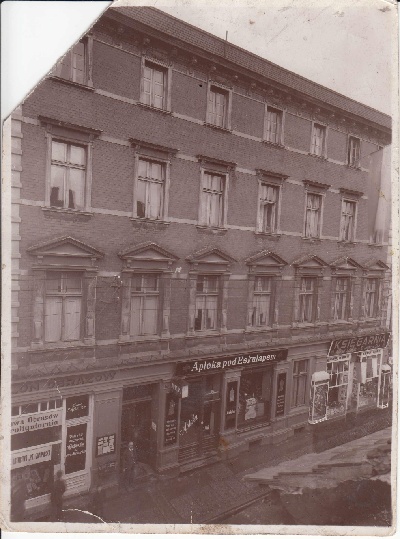
First a few words about me before I tell you the stories that have taken place.
The name Eincla (spoken: Aynzla) comes from the fact that I am a single room. In Silesia, this is the term for a living space, like me. Very simple: one entrance door and two windows. 20 square metres. I have a washbasin. That’s about it. But the special thing about me is: my ceiling is 3.70 metres high. I am on the second floor of an apartment building. A splendid house, which is located in the pedestrian zone near the market place. So right in the centre. But my view goes out to the backyard. I notice less of the hustle and bustle on the busy shopping street. Which does not mean that I was excluded from current events. I am right in the middle of it all and thus part of the story I am telling you.
At the time of my formation I was on German territory. Now that sounds unbelievable. Does it? Although I am a room that tells you stories. But I am not a magic room that moves from one place/ from one country to another. That would go too far. Who would believe my stories if I said I am a room that travels through the world? Eincla, the flying single room. Well, we’ll keep the church in the village(a German phrase). And me in the small Upper Silesian village, which was German territory before the First World War.
The Silesian region has always been special. Here the German language meets Polish. There is even a language of its own here: Silesian, Schlonski (śląski). Nowadays it is also derogatorily called “Water German”. Whether this is a language in its own right, or just a dialect of Polish, you are welcome to discuss it with a linguist. I am just a room that tells you about my life. Neither could I attend a university, nor attend a scientific elaboration of this topic. But I have experienced all this. People who are proud of being a Silesian and who prefer to use this language. People who, depending on who they surround themselves with, switch from Silesian to Polish and then jump further into German. And those who speak only Polish. And vice versa.
That is one thing in itself with these languages. You dear people, if you only knew what the tool of language can accomplish. You would use it much more thoughtfully. Anyway, I am now using this tool to continue with my story.
After the First World War, the discussion started. To riots. To disputes. In the region. Even in one family the opinions were divided. To which country do you feel you belong? To the German Reich? Or rather to Poland? I can only speak of the good fortune that this divided behaviour is foreign to me. I am part of a certain house to which I belong. I could now coordinate with my siblings (the other rooms of the house) as much as we want, but we are part of that house. We remain a part of this house, even if something may change structurally. But I will come to that later.
Upper Silesia is to be considered a linguistically mixed area. And it gets even more complicated: the language a person speaks does not necessarily mean that the person feels that they belong to this country.
In 1921 there was finally a referendum in Upper Silesia. To which country should this region belong? About 60% of the Upper Silesians were in favour of joining the German Reich. 40% of the inhabitants wanted to belong to Poland.
But that is not all. Pro-Polish movements continued to fight for a complete annexation to Poland.
This chapter of Upper Silesian history is so complex and multi-layered at this time that I will abbreviate at this point. Here I refer anyone who wants to delve deeper into the subject matter to do their own research. Or there are certainly people who can talk about this section of German-Polish history in a well-founded way, because they know it better. After all, I am only a single room.
I jump to the event of the Second World War. Because the region of Upper Silesia was directly affected. There was even an attack under false flag on the transmission tower in Gliwice. To start the planned war, a unit was sent from the German side to take possession of the radio station disguised as Polish soldiers. This kind of propaganda was used by the German Reich to get its own project off the ground.
I do not need to say much about the Second World War. The camps and forced places that were set up were German territory and are now part of Poland.
During the war the village where I live was hit by two bombs. One of them hit us. I lost eight siblings. So there it is, the structural change I was subjected to. Since then the house is no longer complete. But we still stick together.
With all the hustle and bustle that took place outside, I didn’t even get a chance to tell what was going on inside. The stories that took place within the four walls. Oh, you know what? I’ll tell you another time.